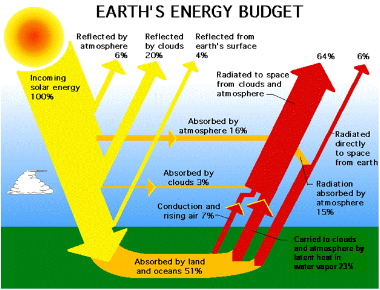
Only about 50 of the sun s energy reaches the earth and then only 15 to 25 of that reaches the grid.
Wavelength of sun absorption on solar panels.
The sun s energy is expressed in different ways depending on what materials it interacts with.
Some places on earth receive more than 4 000 hours per year of sunlight as in the sahara.
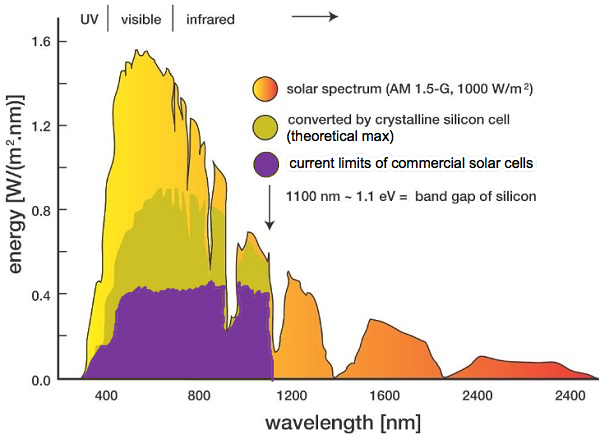
Any energy above the band gap energy is not utilized by the solar cell and instead goes to heating the solar cell.
At these wavelengths each photon has a large energy and hence the ratio of photons to power is reduced.
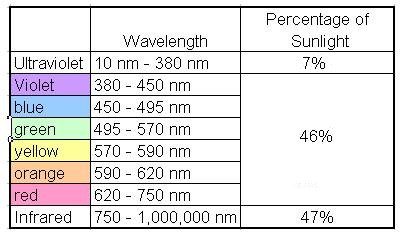
Uv ultraviolet light refers to the region of the electromagnetic spectrum between visible light and x rays with a wavelength falling between 400 and 10 nanometers.
However their performance and energy outputs will never be as high as if they were exposed to sunlight.
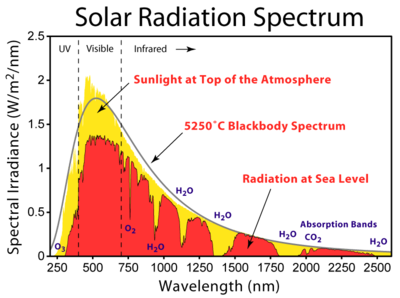
Most of the solar energy falling on earth has wavelengths of wavelengths of 250nm to 2500nm.
The cell s silicon material responds to a limited range of light wavelengths ignoring those that are longer and shorter.
Solar irradiance is often integrated over a given time period in order to report the radiant energy emitted into the surrounding environment joule per square metre j m 2 during that time.
Solar panels can work with artificial light.
However unlike the square shape of qe curves the spectral response decreases at small photon wavelengths.
As shown in the sketch at the far left there are energy losses as the sun s rays are reflected from the atmosphere clouds dust the day night cycle and seasonal changes.
The effect of wavelength on photovoltaic cells.
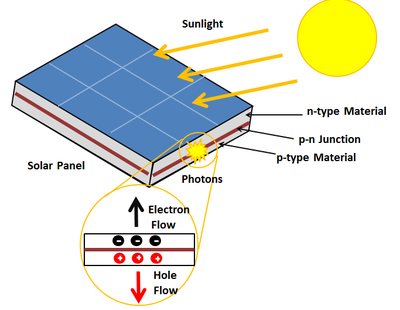
This enables them to transform solar energy into electricity.
Others receive less than 2 000 as in regions of frequent storminess.
Specifically this layered cell is much better at collecting those longer wavelengths of light into the.
The ultimate solar power station is in outer space.
The amount of sunlight is dependent on the extent of the daytime cloud cover.
Solar irradiance is the power per unit area watt per square metre w m 2 received from the sun in the form of electromagnetic radiation as reported in the wavelength range of the measuring instrument.
Sunlight solar radiation that is visible at earth s surface.
This electromagnetic radiation is not visible to the human eye because it has a shorter wavelength and higher frequency than the light our brain perceives as images.
Traditional photovoltaic cells turn a relatively small part of the sun s light spectrum into electricity limiting their efficiency and power output.
Solar panels are built with materials that physically interact with certain wavelengths of solar energy.
The sun emits em radiation across most of the electromagnetic spectrum although the sun produces gamma rays as a result of the nuclear fusion process internal absorption and thermalization convert these super high energy photons to lower energy photons before they reach the sun s.